
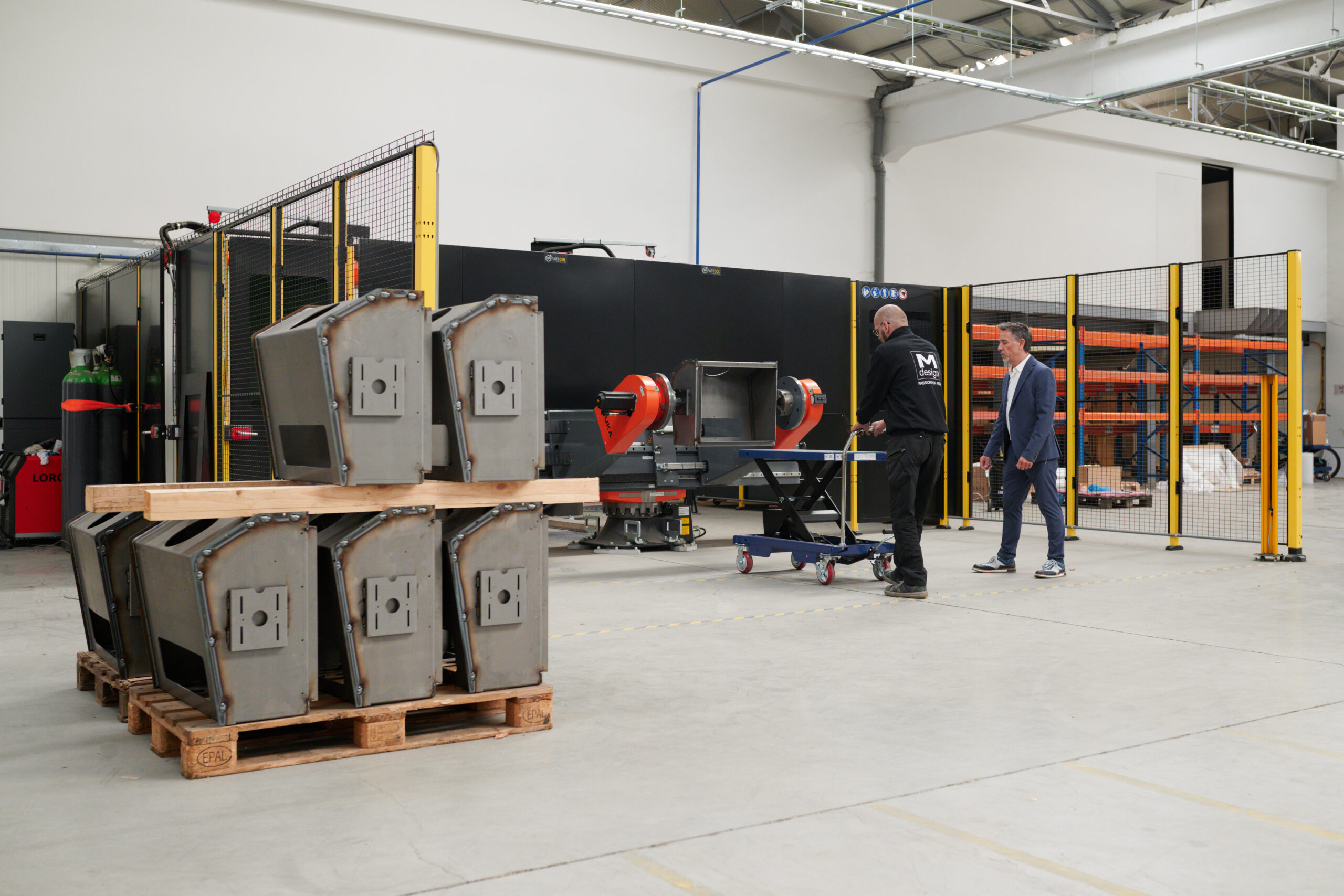
Where many hesitate to invest held back by uncertainty and tensions at Europe’s doorstep, Bart Goovaerts chooses the opposite path: daring to innovate and build the future. This vision is now taking shape in a next-generation factory, where technology and industrial ambition are redefining the energy landscape.
With a facility designed around the most advanced technologies, M-Design is crossing a new industrial threshold. The entire process is engineered to adapt in real-time to market demands, whether for high volumes or bespoke solutions. From flow-based organization and fully digitized preparation to targeted automation, everything is built to reduce lead times, enhance reliability, and guarantee consistent quality.
This industrial leap is no accident; it is a calculated decision made in a climate otherwise unfavorable to investment. As the CEO explains, investing now became a necessity precisely because of this instability: “When everything is stable, everyone moves forward. But when uncertainty sets in, many slow down. We chose the opposite. Waiting would have been more comfortable, but far less strategic.”
From laser cutting and punching to robotic bending and automated welding, precision has reached an unparalleled level, ensuring the repeatability required for both large series and highly specific productions.
Technology that empowers, rather than replaces, the human element
Contrary to popular belief, this technological surge does not come at the expense of the workforce. Instead, it redefines their role.
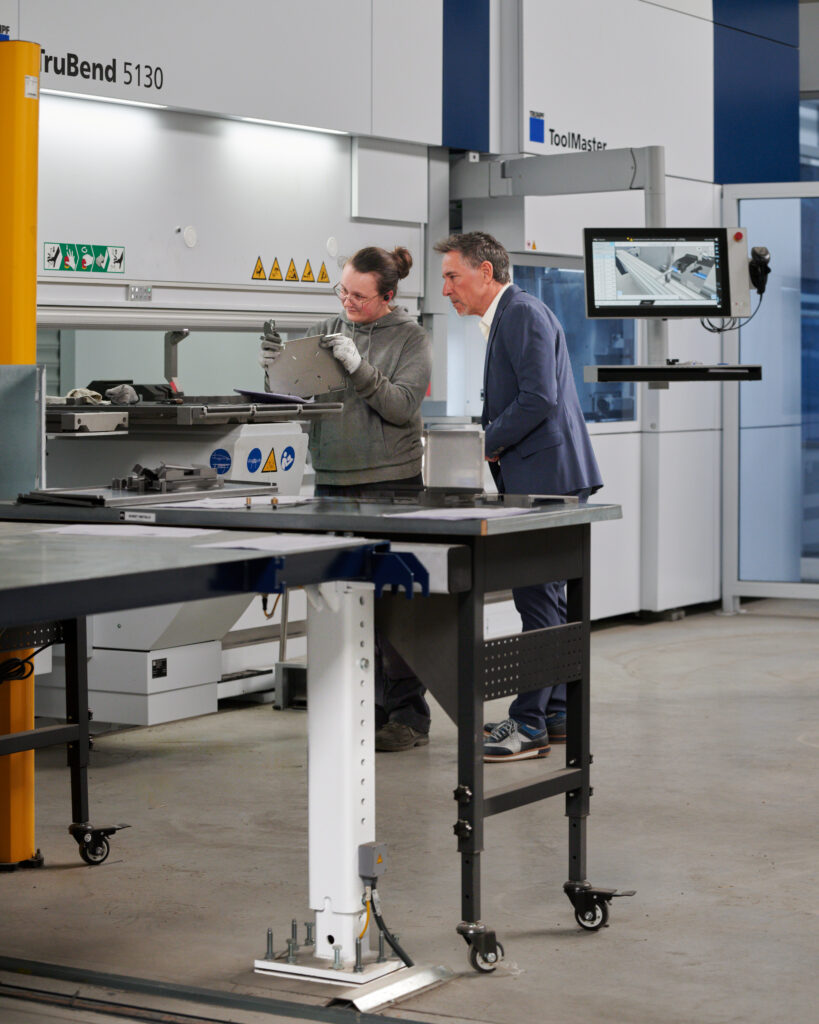
In this next-generation factory, machines provide precision, consistency, and speed. However, humans remains indispensable where technology falls short: managing variations, quality control, aesthetic standards, and adaptability.
This complementarity is what makes the difference. The machine executes; the human refines and guarantees the process. Innovation, therefore, lies not just in the hardware, but in the balance struck between automation and craftsmanship.
Beyond modernizing tools, this new factory meets a dual requirement: producing faster and producing better.
By adopting an organization inspired by Quick Response Manufacturing (QRM), production cycles can be significantly shortened, with estimated gains of up to 60%. Simultaneously, optimized material and workflow management limits waste and boosts overall efficiency.
The energy strategy follows the same logic. The site incorporates approximately 3,000 solar panels paired with storage systems of up to 6 MWh to maximize autonomy and reduce the carbon footprint. Sustainability is no longer a secondary goal; it has become a direct lever for performance.
This global vision is part of a broader interpretation of industrial transformation. For Bart Goovaerts, such decisions follow a historical continuity: “Industry has always been built this way; those who make strong decisions during complex periods often create a lasting gap. We believed now was the right time to invest and prepare for the future.”
Investing in uncertainty: A deliberate choice
Should one wait for stability before acting, or invest while others hesitate?
The energy transition doesn’t just begin with the consumer. It starts upstream, through concrete and sometimes risky industrial decisions.
Investing today in a next-generation factory means mobilizing several million euros, completely rethinking a production tool, and betting on the future in an unstable context. For M-Design, this translates to a capacity increased to 15,000 units per year, significant productivity gains, and an industrial asset built to last.
In an environment marked by geopolitical tensions, market volatility, and energy uncertainty, many players are slowing down and waiting. Yet, it is precisely in these moments that future industrial balances are struck.
Far from a reckless gamble, this strategy is rooted in a long-term vision, as the CEO emphasizes: “This is not about speculation. Demand is evolving, energy expectations are changing, and we had to adapt our industrial tools today.”
Investing in uncertainty is therefore more than just taking a risk. It is a way of redefining one’s position in a changing market. In industrial history, those who move forward through the fog don’t just take a risk, they often take the lead.
Looking back, Bart Goovaerts leaves no room for doubt. He would make the same choice again without hesitation. “Because in a few years, the question won’t be ‘should we have invested?’, but ‘who got ahead?'”